
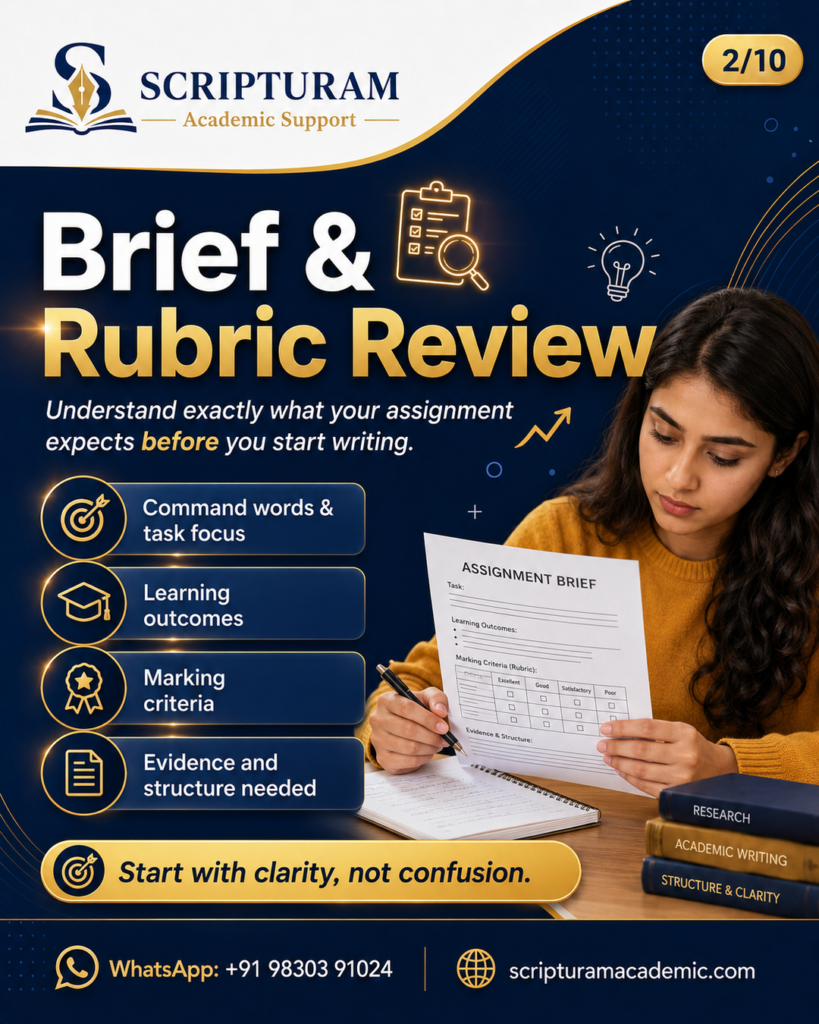
Many students start writing an assignment before they fully understand what the assignment brief is asking. This often leads to weak structure, missed learning outcomes, poor use of evidence and unnecessary rewriting near the deadline. A good assignment does not begin with writing; it begins with understanding the brief.
An assignment brief is more than a topic. It usually explains the task, word count, learning outcomes, assessment criteria, submission requirements and sometimes the expected structure. If these details are ignored, even a well-written answer may lose marks because it does not respond properly to the task.
Why the Assignment Brief Matters
The assignment brief tells you what the marker expects. It helps you understand the purpose of the task and the areas you need to cover. Before writing, students should read the brief carefully and highlight the most important parts.
You should look for the topic, command words, learning outcomes, word count, referencing style and marking criteria. These details help you decide what to include, how much detail to provide and how to organise the assignment.
For example, if the brief asks you to “evaluate” a marketing strategy, you should not only describe the strategy. You need to discuss strengths, limitations, evidence and reasoned judgement. If the brief asks you to “explain”, the focus may be more on clarity and understanding. Different command words require different academic responses.
Understand the Command Words
Command words are key instructions in the brief. Common examples include describe, explain, analyse, evaluate, compare, discuss and critically assess. Each command word tells you the level of academic thinking required.
“Describe” usually means presenting information clearly. “Analyse” means breaking the topic into parts and explaining relationships. “Evaluate” means making a reasoned judgement based on evidence. “Critically discuss” usually requires balanced arguments, evidence, limitations and conclusion.
Students often lose marks when they treat all command words in the same way. A descriptive answer may not be enough for a task that requires analysis or evaluation.
Check the Learning Outcomes
Learning outcomes show what the assignment is designed to test. They are often listed in the brief as LO1, LO2, LO3 or similar. Each learning outcome should be reflected in your assignment structure.
Before writing, check whether your planned headings match the learning outcomes. If one learning outcome is missing from your plan, the assignment may be incomplete. A useful method is to create a simple table with three columns: learning outcome, relevant section and evidence needed. This helps you ensure that every required area is covered.
Read the Marking Rubric
The marking rubric explains how the assignment will be assessed. It may include areas such as knowledge, understanding, analysis, application, structure, referencing and presentation.
Many students read the assignment question but ignore the rubric. This is a mistake. The rubric helps you understand what separates a basic answer from a stronger answer. For example, if the higher grade criteria mention critical analysis, wider reading or application of theory, your assignment should include these elements.
The rubric should guide your writing plan. It tells you where to focus your effort and how to improve the quality of your work before submission.
Plan the Word Count
Word count planning is important because it helps you balance the assignment. If the introduction is too long, there may not be enough space for analysis. If one section is overdeveloped, another learning outcome may be too weak.
A simple word count plan can make the writing process easier. For example, in a 3000-word assignment, you may allocate around 300 words for the introduction, 2200 words for the main discussion, 300 words for the conclusion and the remaining space for transitions and explanation. The exact split depends on the brief, but the key point is to plan before writing.
Identify Evidence Requirements
Academic assignments need evidence. Evidence may include books, journal articles, reports, case examples, data, policy documents or industry sources. The type of evidence depends on the subject and level of study.
Before writing, ask yourself what evidence is needed for each section. If your assignment includes many claims but limited sources, the argument may appear weak. Strong academic work usually connects theory, evidence and analysis.
Common Mistakes Students Make
One common mistake is writing from general knowledge instead of the assignment brief. Another mistake is using headings that do not match the learning outcomes. Some students also focus too much on description and not enough on analysis.
Referencing is another frequent problem. If sources are not cited properly, the academic quality of the work may be affected. Students should check the required referencing style, such as Harvard, APA or another system, before finalising the assignment.
How SCRIPTURAM Can Support Academic Planning
SCRIPTURAM supports students with assignment planning, brief understanding, rubric review, skeletal modelling, gap analysis, proofreading, referencing and dissertation planning. The aim is to help students understand academic requirements and improve the clarity, structure and presentation of their work.
If you are confused by your assignment brief, it is better to seek guidance before writing rather than after completing a full draft. A clear plan can save time and reduce unnecessary revision.
Need help understanding your assignment brief or planning your assignment?
Contact SCRIPTURAM through the Student Enquiry tab or message us on WhatsApp.
WhatsApp: +91 98303 91024
Website: scripturamacademic.com
Need academic planning or review support?
SCRIPTURAM supports students with assignment planning, brief and rubric understanding, gap analysis, proofreading, referencing and dissertation planning.